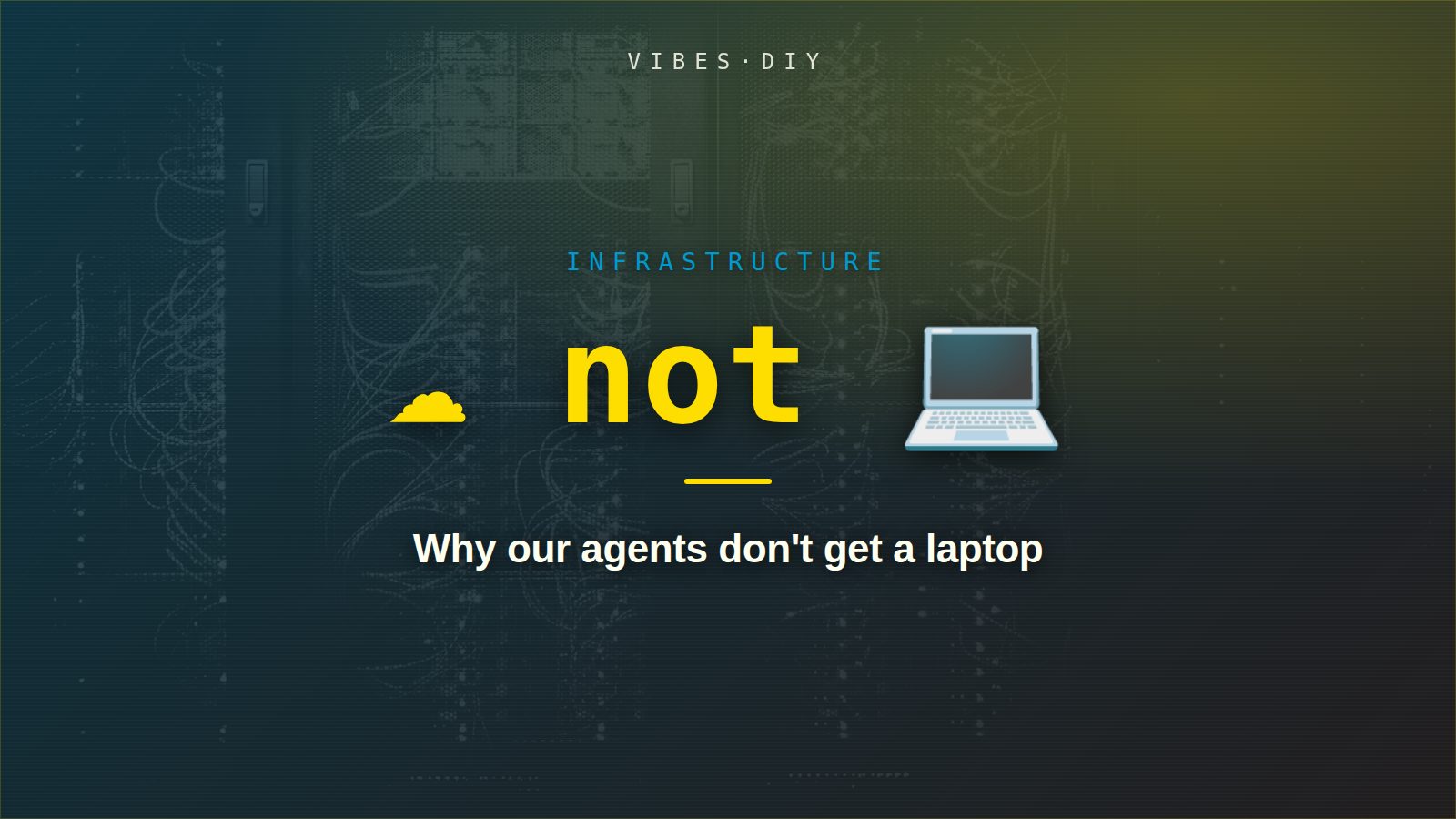
Why our agents don't get a laptop
The fastest way to make an agent's work reproducible is to stop running it on your machine. We want agent work — including browser QA — to happen in ephemeral cloud containers by default: not as a heroic stunt, but as the boring, standard place it runs. The reasoning is almost embarrassingly simple — a capability that only works on a hand-configured laptop quietly pushes everything back toward the laptop.
Look at what it takes to drive a browser QA pass on a workstation. It's a real checklist: install Chrome, authenticate gh, and the genuinely fiddly one — seed a Google Workspace session into a specific chrome-devtools profile directory, once per engineer, being careful not to pollute it. That's per-person onboarding that rots, drifts, and silently differs between machines. "Works on mine." The cloud version is a SessionStart hook: every session, every agent, identical setup, zero steps. The capability stops being a thing a few people have configured and becomes a thing the fleet just has.
That difference is the whole point. A check that needs setup gets skipped under deadline; a check that's already wired up gets used. We want validation to be standard operating procedure — every PR exercises what it changed against a real running environment before it's called ready, the same way every PR gets a blog seed and a review. You cannot mandate a step that only works on some machines. An SOP has to be universally available first, and it has to scale to many agents in parallel, each in an isolated container — which a shared laptop never will.
There's a principle hiding in here worth saying out loud: reproducibility beats power. The cloud Chromium is not more capable than a developer's Chrome. It's more uniform. For an agent, a clean, identical, disposable environment every run is worth more than a powerful bespoke one, because it removes the entire class of "it behaved differently on my setup" failures and makes a result something anyone can re-run and trust.
But wanting agents in the cloud and actually getting them to see the product there are two different things. Three war stories from the getting-there.
| Symptom | Cause | Fix |
|---|---|---|
Every HTTPS navigation dies net::ERR_CONNECTION_CLOSED, but curl through the same proxy returns 200 | Chrome's TLS 1.3 ClientHello (PQ key share + GREASE) spans two TCP segments; the egress proxy's SNI parser reads only the first and resets | --ssl-version-max=tls1.2 for a compact single-segment ClientHello — not a verification downgrade |
CLI against a PR preview worker fails [authentication_required] with the normal device cert | Previews share dev's bindings, so their certs come from the DEV CA, not vibes.diy | A second headless cert, VIBES_DEVICE_ID_PREVIEW (delete ~/.fireproof/keybag/ first — an existing login always wins) |
POST /cdn-cgi/rum 404s on every page load | Automatic RUM setup points the beacon at your own zone path, but /cdn-cgi/* never reaches the SSR Worker | Manual "JS Snippet" install gated by enableCfRum = env.ENVIRONMENT === "prod" && request.cf?.isEUCountry !== "1", posting to cloudflareinsights.com |
The TLS handshake that broke every screenshot
Pointing mcp__chrome-devtools__* at vibes.diy from a cloud session meant clearing four layers. Three were boring: no Chrome binary at the expected path (shim to the Playwright Chromium), runs as root (--no-sandbox), no display (Xvfb). The fourth was the interesting one.
Get posts like this in your inbox
One email field. Real updates. No algorithm required.
Every HTTPS navigation died with net::ERR_CONNECTION_CLOSED — but curl and openssl s_client through the same egress proxy returned 200 and the real origin cert. So the proxy worked, the CA was fine (it's pass-through, not MITM — it presents the origin's real cert), and Chrome was definitely using the proxy. Headless Chrome's stderr gave the tell: handshake failed; SSL error code 1, net_error -100. The connection was dying during the TLS handshake.
The cause: the egress proxy enforces per-host policy by reading SNI out of the TLS ClientHello, then splicing a raw tunnel to the origin. Chrome's TLS 1.3 ClientHello is big — a post-quantum key share (X25519MLKEM768) plus GREASE push it past one TCP segment. The proxy's SNI parser reads only the first segment, can't reassemble, and resets. curl and openssl never tripped it because their ClientHello fits in one segment.
The fix is one flag:
sh--ssl-version-max=tls1.2
That yields a compact, single-segment ClientHello. Crucially, this is not a verification downgrade — the proxy is pass-through, so Chrome still does a real TLS handshake with the origin and validates against its built-in roots. We proved it by loading the site with a completely empty NSS store.
Two lessons stuck. First: "curl works but the browser doesn't" is a fingerprint, not a fluke. When a policy middlebox parses the ClientHello, the size and shape of that hello — not just the destination — decides whether you get through. Reach for the byte-level tell (net_error -100 mid-handshake) before blaming certs. Second: a tempting red herring. Importing the proxy CA into Chrome's NSS store felt like progress, and the next attempt succeeded — but the CA import was irrelevant; the TLS-1.2 cap applied in the same step was the actual fix. Always re-test the minimal change in isolation before writing it into a setup script you'll ship. The shipped scripts/setup-cloud-browser.sh is smaller and more honest for it.
Why a PR preview needs a different device cert
QA against a preview means QA against the preview worker, and that's where the auth model gets interesting. Point the vibes-diy CLI at a PR's preview worker:
shVIBES_API_URL=https://pr-<N>-vibes-diy-v2.jchris.workers.dev/api
...and the normal device cert fails with [authentication_required]. Previews share dev's bindings, so their certs are issued by the DEV CA, not vibes.diy. The fix is a second headless cert, VIBES_DEVICE_ID_PREVIEW.
The gotcha worth knowing: the CLI only seeds its keybag when it's empty — an existing login always wins. So switching environments mid-session silently keeps the stale cert until you delete ~/.fireproof/keybag/. Once you see it, the dev/prod/preview CA split makes sense, and the slow compile_test window becomes a chance to validate changed features against a real preview instead of just unit tests.
The 404 you can't fix in your Worker
Every page load fired POST vibes.diy/cdn-cgi/rum and got a 404 — a console error plus a failed-network entry on every route. Cloudflare's Web Analytics "Automatic Setup" injects a RUM beacon and, for ad-blocker evasion, points it at your own zone path, /cdn-cgi/rum.
The obvious fixes are all wrong. You can't intercept it in the Worker — /cdn-cgi/* is served by Cloudflare's edge before the request reaches any Worker. (Proof: curl /cdn-cgi/trace returns Cloudflare's trace dump that no Worker code generates.) And automatic injection isn't reliable for Worker-rendered HTML in the first place; vibes.diy is 100% SSR-in-the-Worker, which is exactly why the zone-path beacon 404s.
The real fix flips the dashboard to manual "JS Snippet" installation and injects the beacon yourself in the SSR <head>. The manually-installed beacon posts to cloudflareinsights.com/cdn-cgi/rum — Cloudflare's own domain — so it never touches our zone or Worker. No 404, same dashboard.
Manual setup loses Cloudflare's automatic "exclude EU" carve-out, but because we render in the Worker we have request.cf.isEUCountry and rebuild the posture in one line:
jsenableCfRum = env.ENVIRONMENT === "prod" && request.cf?.isEUCountry !== "1"
The === "prod" half matters: a manual-install beacon attributes data by token, not hostname, so a prod token firing from a preview host would pollute the production analytics site. Trade accepted — the cloudflareinsights.com collector is a little more ad-blockable than the same-origin path, a fine price for killing a 404 on every page.
The honest edge
There's a gotcha we haven't solved, and it's worth naming. The thing that makes cloud containers safe and reproducible — no ambient credentials, a cold profile every run — is exactly why the authenticated QA spine can't fully run there yet. There's no signed-in session to borrow. How do you give an isolated, ephemeral agent just enough identity to test a logged-in flow without handing it standing access? That's still open. But the direction is settled: the default place an agent looks at the product is the cloud, because that's the only default that everyone shares.
Built and checked in the cloud, by default.
The same uniform environment our agents validate in is the one your apps run in. Type a sentence; ship something real.
Start building →