
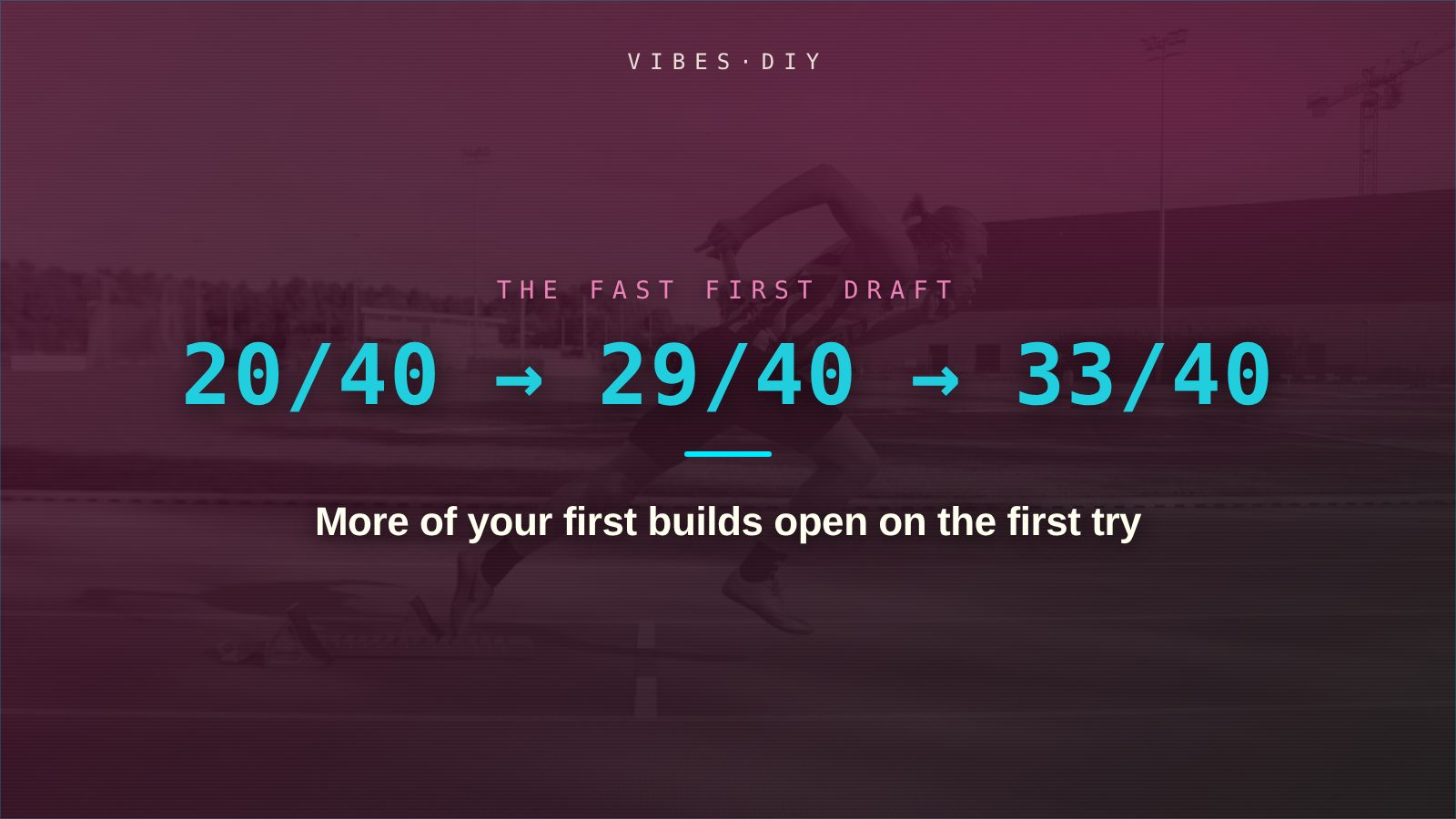
More of your first builds open on the first try
When you describe an app on Vibes DIY, a fast model gets the first word. It reads your sentence and writes a quick first read of what you meant, it sketches a first look of the app that paints on screen within seconds, and, if you have instant builds switched on, it drafts whole apps that race the careful builder. That model is Mercury, from Inception, and a new generation of it shipped today. As of today every one of those fast first drafts comes from Mercury 3.
What a first draft has to do
A draft is only useful if it opens. Before any draft reaches you, it goes through the same gate: every file has to parse, every import has to point at something real, and nothing can refer to a name that was never defined. A draft that fails the gate costs a few seconds and a fraction of a cent, and another draft or the careful builder takes its place. A draft that passes is the app you see first.
So the question for a new model is simple. Send it the exact request our servers send, with the same look, the same brief and the same budget, and count how many of its drafts open.
The numbers
We did that on ten of the app ideas we test with, from a drum machine to a neighborhood problem-reporting app to a weekend trip cost splitter, four drafts each, for the old model and the new one.
| Model | Drafts that opened | Typical time | Slowest draft |
|---|---|---|---|
| Mercury 2.5 | 20 of 40 | 5.3 s | 14.0 s |
| Mercury 3 | 29 of 40 | 4.1 s | 9.7 s |
Mercury 3 won or tied on eight of the ten ideas, faster at the typical draft and much faster at the slow end. "Opened" here means the draft passed our static gate, and the times are the model's reply times, not the whole wait until your app appears. A cookie-shop order form that Mercury 2.5 never got to open, Mercury 3 opened four times out of four.
Get posts like this in your inbox
One email field. Real updates. No algorithm required.
The failures changed kind, too, and that turned out to be the interesting part. Mercury 2.5 mostly failed by writing a draft that didn't parse: a tag left open, a template string that never closed. Mercury 3 parses almost everything it writes: two parse failures in forty, against fourteen. Four of its eleven failures were small slips the next step already knows how to fix, like a component the draft forgot to import. The other five were new.
Five times out of forty, Mercury 3 did something the old model never did: it answered with one sentence describing the app, and no code. Four of those five were for the potluck board.
One more line
Our brief ends with a short fixed paragraph about what a first build is, and its last line asks for the files. Mercury 3 was reading "one sentence before the first file" and stopping at the sentence. Mercury 2.5, in its own no-code failures, was writing the code and leaving off the heading that tells us which file it is.
Both are the same mistake from different directions: the answer's shape was in the prompt, but not at the end, where a fast model reads last. So we added one line at the end of the brief naming the two files and their headings, and ran the whole bench again.
| Model | Before the line | After the line |
|---|---|---|
| Mercury 2.5 | 20 of 40 | 29 of 40 |
| Mercury 3 | 29 of 40 | 33 of 40 |
The sentence-only answers went from five to one. The old model's no-code drafts went to zero, and half of its parse failures went with them. In this test the slowest draft on either model now lands in under eight seconds, 7.6 for Mercury 2.5 and 7.0 for Mercury 3. The line ships with the model.
The quick first read holds
The fast model also writes the quick first read of your idea, the short set of user-story cards the first build starts from. That is a different request with a different shape, so we checked it separately: the same ten ideas, four reads each.
Mercury 2.5 wrote a complete read forty times out of forty. Mercury 3 wrote one thirty-eight times, and in the other two it wrote all the cards and the whole closing block but left out the opening marker line that introduces the cards. Our reader scans from the top when that line is missing, so it still found every card. Mercury 3 also writes a card or two more per read and names more of the records the app will keep. No sentence-only answers there at all.
What you'll notice
The first look of your app, the one that paints while the builder is still working, comes from Mercury 3 now. So does the quick read it builds from, and so do instant drafts if you've turned them on. The draft that opens first is a little more likely to be the fast one, and in our test the slowest draft came down from about fourteen seconds to about seven.
Mercury 3 reasons by default, which the old model didn't, and we switch that off for every first draft. A fast model's job here is the quick, unfiltered first impression, and we measured last time that thinking first made that impression slower and no better. What we want from the new generation is exactly what we got: the same quick read, written more carefully.
Describe the app you want
A first look in seconds, a first build that opens, and the careful version a ⭐ away.
Start building →