Pickathon made the fan-made planner official — your festival could be next
If you help run a music festival — a Bumbershoot, an Outside Lands, a Sasquatch!, a Newport Folk, a Pitchfork, a Treefort — you already know the perennial problem: your lineup is gorgeous, your schedule is a PDF, and your fans are building their nights in a group chat and a screenshot. This is a story about a festival that fixed that without hiring anyone, and an invitation for yours to do the same.
Pickathon made it official
Two summers back, a Pickathon regular named Meghan Sinnott — who these days runs Community for Vibes DIY, among her other responsibilities — wanted a better way to plan her weekend on the farm, so she vibed one into existence in a single afternoon — no engineers, no budget, just a prompt on Vibes DIY. Browse the lineup, star the sets you can't miss, jot private notes, block out your meal and volunteer times, compare picks with friends. It was a personal itch-scratcher. It became a grassroots hit: people pulled it up at the gate, traded QR codes, argued over who starred what.
This year, Pickathon liked it enough to make it official. They're co-marketing the built-out version to their audience as Pick. Plan. Share. — their lineup, their frog, their season art, front and center:
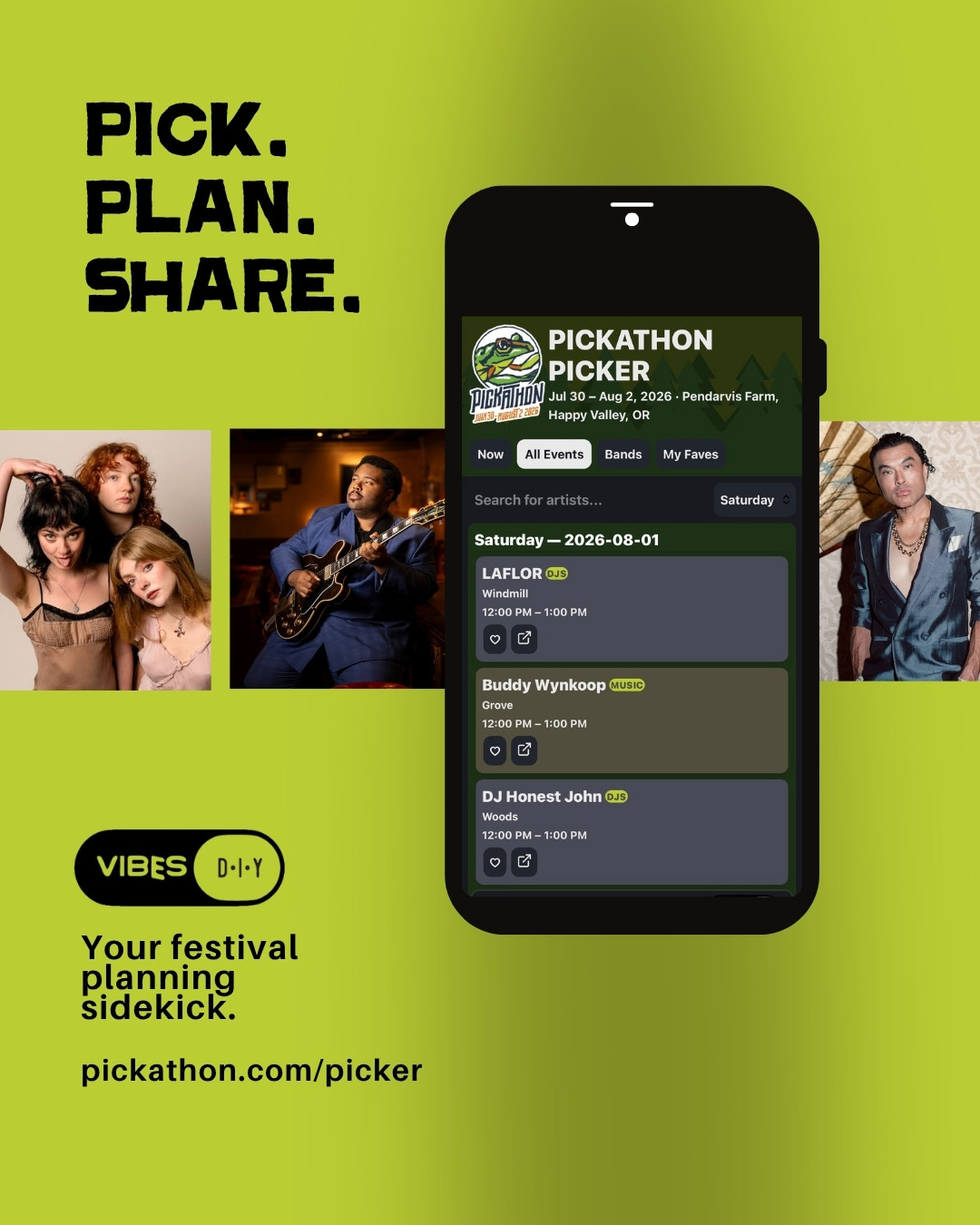
That's the whole arc: a fan solved her own problem, the community adopted it, and the festival backed the fan. Pickathon made a genuinely smart call here — they didn't commission a six-figure app, they recognized a thing their people already loved and put their name behind it. It reads the live schedule, so it's never a stale PDF, and it cost them essentially nothing to stand up.
Get posts like this in your inbox
One email field. Real updates. No algorithm required.
Your festival, same app, one conversation
Here's the part for everyone other than Pickathon reading this. There is nothing Pickathon-specific about how this was built. The whole app — the lineup browser, the public star counts, the private notes, the friends-who-can-see-each-other's-picks sharing model — is a remix away for any festival.
And "remix" is not a euphemism for a services engagement. If you have some technical acumen and administrative reach over your festival's data, standing up your own version is about as hard as telling a coding agent how to reach your schedule feed. Point it at your lineup API, describe who should see what ("stars are public, notes are private, plans can be shared with friends"), and the agent produces the whole thing — data model, views, and the fiddly permission rules included. We know, because we've watched a single plain-English paragraph reproduce this exact app end to end.
One thing to tell your developer: the CORS gotcha
If a developer on your side picks this up, save them an afternoon of head-scratching with
one fact. Most festival schedule feeds don't send CORS headers (Access-Control-Allow-Origin),
which means a browser can't fetch them directly from a web app — the request is blocked
before it starts. (Pickathon's feed happens to allow it, which is why the original could
fetch it straight from the page. Yours probably doesn't.)
The easiest fix is often the most direct: if you have admin reach over your own feed —
and if you're reading this, you probably do — just add the Access-Control-Allow-Origin
header to it. One header, and the app can fetch your schedule straight from the browser
the way it does Pickathon's — no backend, no cache, nothing to run. Do that if you can;
the rest of this section is for when you'd rather not have every fan's browser hit your
API directly — or can't touch the feed at all.
The wrong fix is to stand up a live proxy that re-fetches your feed on every visit — now you're running a server, and you're hammering your own API once per fan. The right shape is a scheduled server-side fetch that caches the schedule as a single record your app reads:
- A server-side job pulls the feed on a timer — every few minutes, say.
- It stores the result as one singleton document in the app's database.
- Every visitor reads that one synced record. Zero client-side cross-origin calls, and your API gets hit on a schedule instead of per-pageview.
On Vibes DIY this is the natural job for a vibe's backend.js:
a scheduled handler fetches the feed server-side and writes it to the app database as
the owner, one record every client reads. One honest detail: a backend fetch plays by
the same opt-in rules as a browser — it's admitted when your feed sends that same CORS
header — so the one-header fix above is still the unlock. What backend.js changes is
the shape: one scheduled fetch instead of one per fan. And if you genuinely can't add
CORS to your feed, we can approve you on our side: ask us, and we'll vet your feed's
host onto the platform's reviewed egress allowlist so the scheduled fetch works without
you touching the feed at all. The principle holds regardless of platform: fetch on a
schedule, cache a singleton, never proxy per request.
The takeaway
A festival's most-loved companion app doesn't have to be a line item. Pickathon's is a fan's afternoon idea that the festival was smart enough to embrace. If you've got a lineup and a feed, yours is one good prompt away.
Bring your festival's schedule to life
Point a coding agent at your lineup feed and describe who sees what. The planner builds itself.
Start building →