If tokens were free, we'd precompute every chip
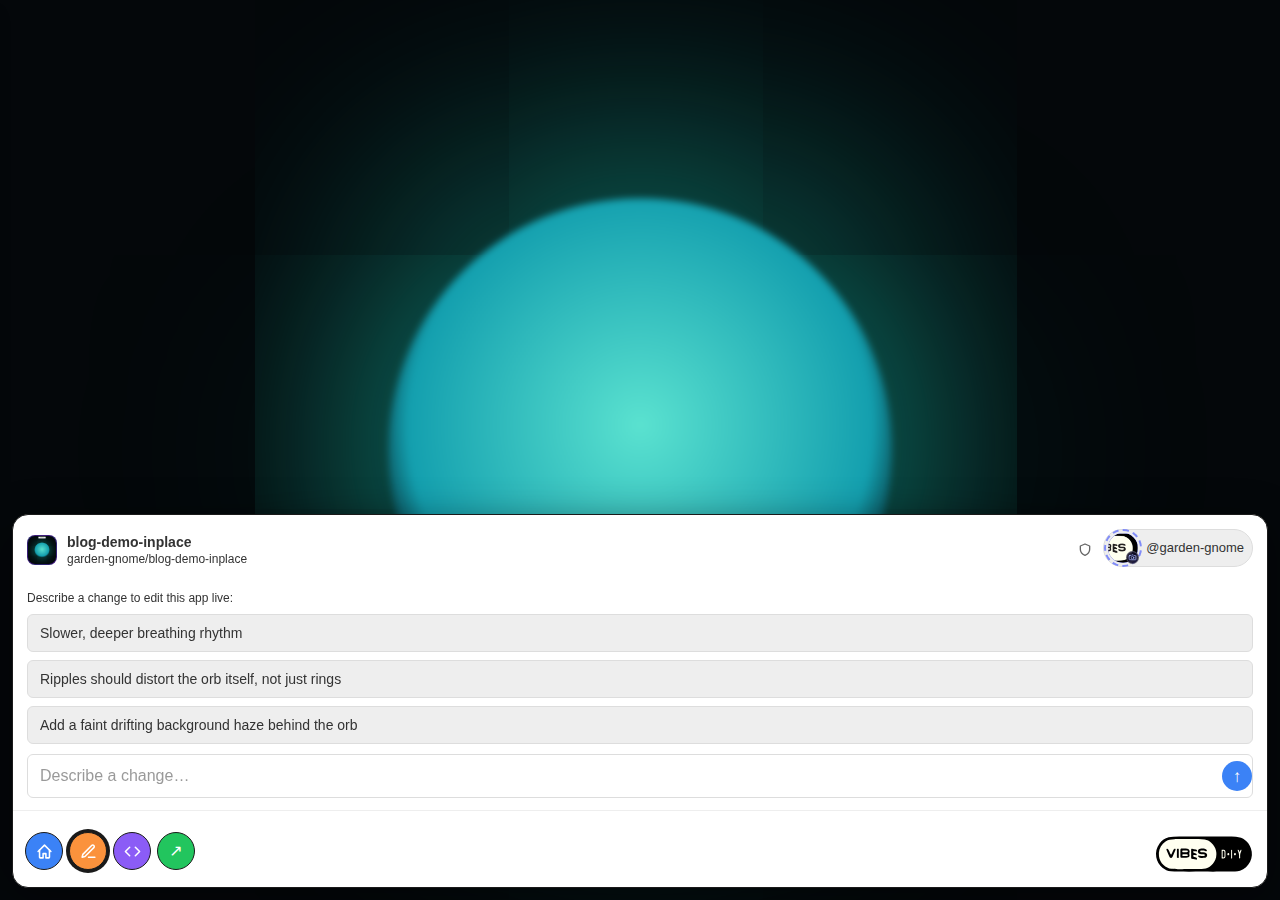
Every Vibe carries a few suggestion chips — small, curated "try this next" edits offered right on the app. Tap one and the app changes. But a chip isn't a shortcut to a pre-baked result: it's a transform of the vibe you're on, and running it is real codegen that costs real tokens. As jchris put it: if tokens were free, we'd precompute every chip. They're not, so we did the next best thing — we cache the ones people actually click.
This is the story of that cache, and of the part that took the real work: not making a click fast, but deciding who is allowed to read a result somebody else paid to generate.
A chip is a content-address
The cache key is the whole trick. A chip's result is fully determined by what you transformed and what you asked for: the source vibe version plus the (normalized) transform text. Hash those together and you get a deterministic content-address — cf-<hash>-<hash> — that the same chip on the same version always produces. The first time anyone clicks it, codegen runs and stages a result under that key. Every click after that is an O(1) lookup.
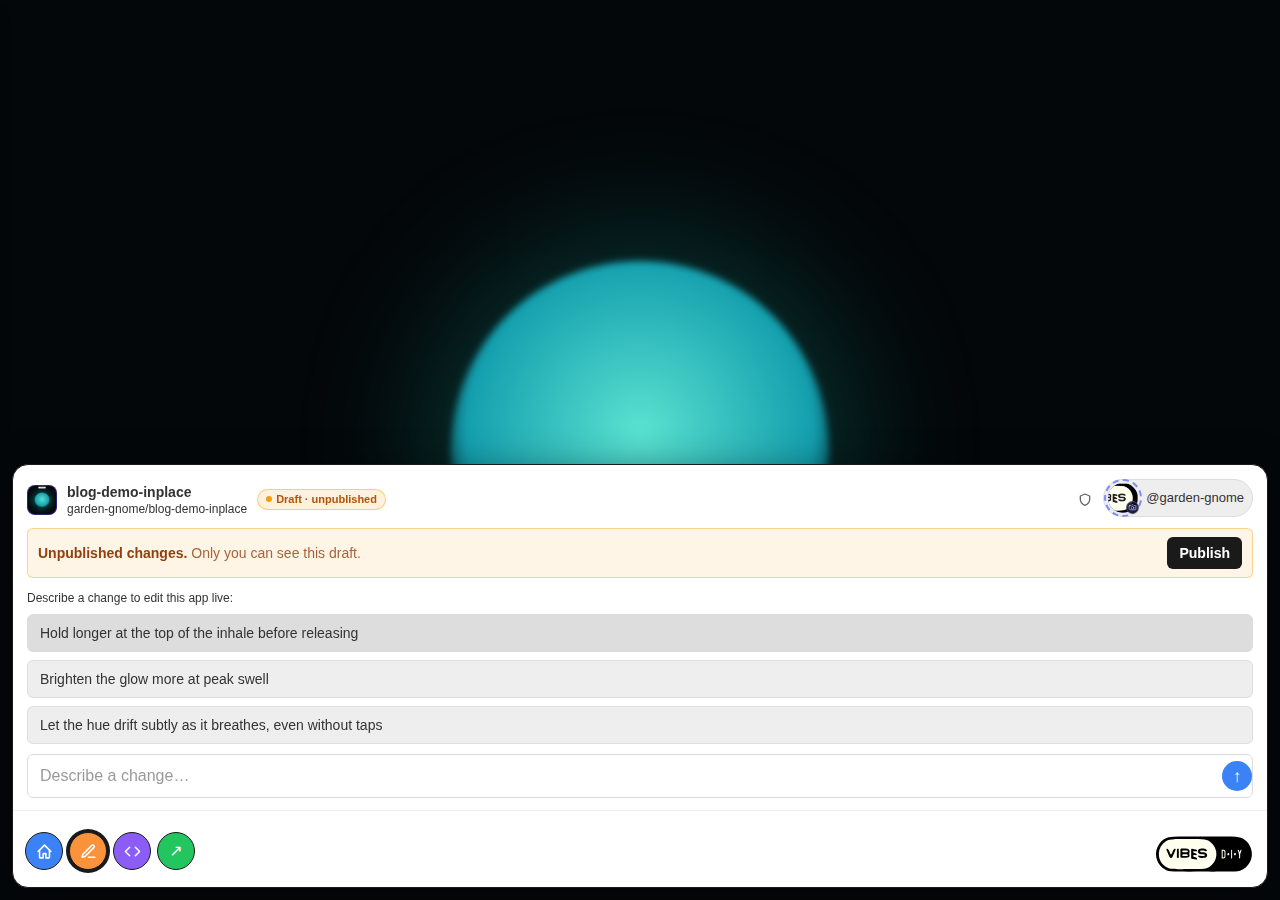
Crucially, the staged result isn't a fork or a new app. It's a new version under the source vibe's own owner and slug — same place, new code. Precompute stages versions; it never advances the public HEAD. The owner publishes if and when they want.
A hit is a read; a miss is a write
The read/write decision is made before anything commits, and it depends on exactly one thing: does a staged result exist for this key?
- Hit → it's a read. Navigate to that version. No codegen, no login, no fork.
- Miss (or any lookup error) → it soft-fails to the write lane, where the existing fail-loud generation path takes over.
What it deliberately does not depend on is who clicked. The lookup is identity-free. Identity only matters in the write lane it falls through to — an owner edits in place; a non-owner forks. Keeping identity out of the read decision is what lets the same cached result serve a signed-in owner and an anonymous visitor through one code path.
Get posts like this in your inbox
One email field. Real updates. No algorithm required.
So the owner's first click is the write that fills the cache:
The hard part: a precomputed result is a permission question
Here's where a cache stops being a cache. Serving a staged version to a visitor means serving code derived from someone's vibe — possibly to someone who isn't signed in. "It's just a transform of a public app" is almost a safe assumption, and almost-safe is exactly the kind of assumption that leaks. So the serve path is deny-by-default, with three gates that all have to agree:
- Visibility — the read uses the same gate as the chips themselves: it serves when the app is public-readable, or to a signed-in owner/member. It is never owner-scoped, and a miss returns the same answer as "not visible" — so it can never become an existence oracle.
- Bless — and this is the one that does the heavy lifting. A produced result is not the same as a servable one. The owner has to explicitly bless a specific result before it serves as a fast-path "stay"; everything unblessed forks. Blessing is a server-authenticated, owner-only action recorded over the exact
{key, fsId, sourceFsId}tuple, and it's independently revocable. Revoke it and the read drops straight back to forking. - Source-was-public — the serve path re-verifies that the source version the result was derived from was itself publicly readable, on that exact entry. A cached read has to be a transform of already-public code — never a window into an owner's unpublished draft.
The default across all three is the same: when in doubt, fork. A miss, a private source, an invisible app, even a settings-read error all degrade to the identical "no cached result here" answer. We call it fail-to-fork: the unsafe direction is never the fallback.
"The UI only sends safe keys" is not "the endpoint only accepts safe keys"
One more gate, at a layer that's easy to forget. The read endpoint is public, and its request schema only requires key: string. The chip keys the UI sends are content-addresses with no PII in them — true. But "the UI is well-behaved" is a statement about the caller, not the endpoint. A non-browser caller could stuff PII or an oversized blob into key and have it land in production logs.
So the PII guarantee lives at the log boundary, not in the caller's good manners. The reader echoes key into telemetry raw only when it matches the canonical cf-<hash>-<hash> shape (and length); anything else is redacted to <non-canonical:LEN> — still debuggable, never persisting attacker-controlled input. The shape check lives right next to the key producer, so the two definitions can't drift apart.
And because the read lane fails to fork — a real infra hiccup looks identical to a cold cache — each lookup emits one structured outcome (hit | miss | lookup-error). Separating lookup-error out is the whole point: a spike there means infrastructure, not user behavior. A safe failure mode is a terrible observability mode unless you instrument it.
The shape of it
A suggestion chip is a deterministic transform, so its result is cacheable; the cache key is just the content-address of (source version, transform). The read/write decision is identity-free, so one path serves everyone. And a precomputed result serves to a visitor only after it clears three independent gates and the owner has explicitly blessed it — with the unsafe answer wired as the fallback at every step, and the public log boundary redacting anything that isn't a real content-address.
The cheapest click is the one you've already paid for. The safest cache is the one that serves nothing until the owner says so.
Tap a chip. See what's cached.
Open a Vibe, try a suggestion, and keep changing it just by talking to it.
Start building →