Seven interactive thought experiments drawn from the Stanford Encyclopedia of Philosophy — tacit knowledge, the knowing body, situated epistemology, and the AI consciousness boundary.
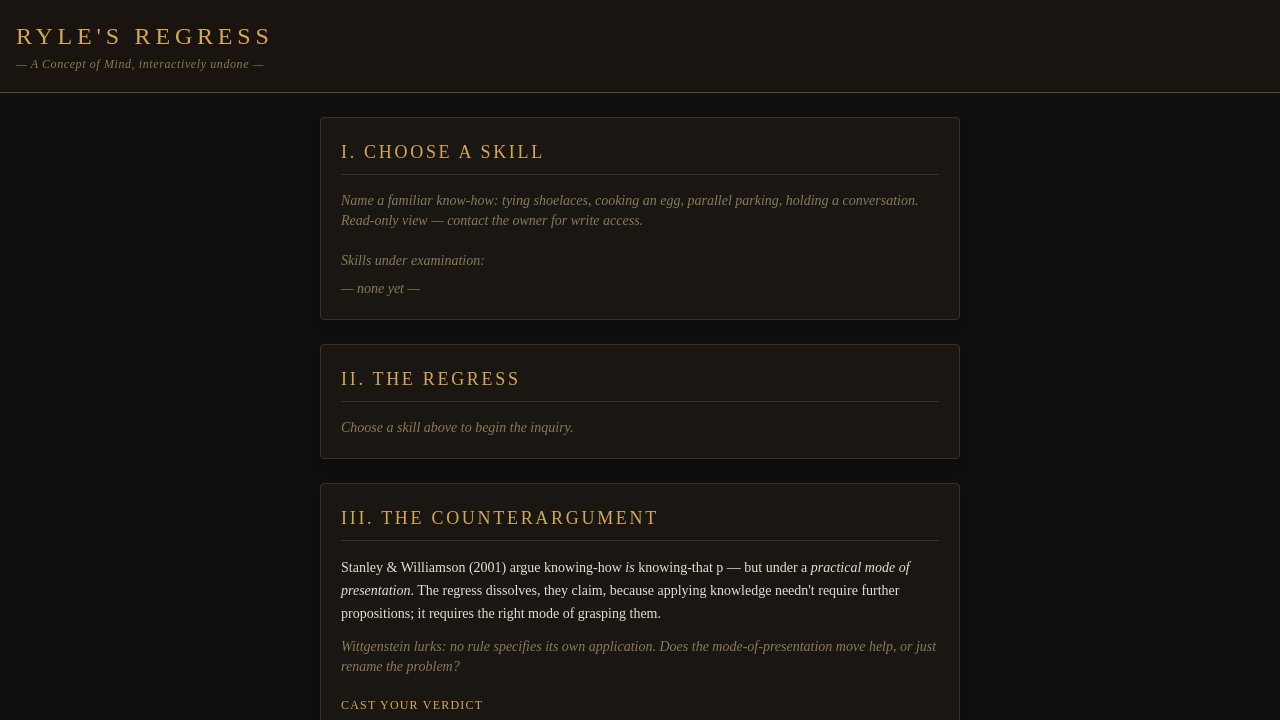
Ryle's regress shows that skills can't be fully reduced to rules — applying any rule requires knowing how to apply it, all the way down.
Cognition isn't housed in the brain and borrowed by the body — it's constituted by the body's engagement with the world.
The knower's position isn't bias to subtract — it's epistemically constitutive. Objectivity requires locating yourself, not erasing yourself.
Each app is a thought experiment, not a lecture.
Each draws directly from a Stanford Encyclopedia of Philosophy entry.
Four thought experiments where you can't separate cognition from the body — the cane, the dancer, the native speaker, the phantom limb.
Focusing on disability studies and prosthetics as extended cognition? Clone it and reframe the cases around assistive technology and phenomenology of disability.
A guided phenomenological exercise — Husserl's intentionality, Heidegger's tool-being, Merleau-Ponty's body schema.
Pairing this with Sartre's being-for-others or Beauvoir's situated freedom? Clone it and add a fourth exercise foregrounding intersubjectivity.
Haraway's view from nowhere, Harding's standpoint epistemology, Fricker's epistemic injustice — the knower's position as epistemically constitutive.
Running this as part of a science studies or STS course? Clone it and center Collins and Evans on expertise alongside Haraway — the situated/objective tension maps directly.
Four vignettes — evaluate the reasoner's intellectual character, not just their conclusion. Sosa's reliabilism vs. Zagzebski's responsibilism.
Want vignettes drawn from scientific reasoning and testimony rather than everyday belief? Clone it and swap the cases — intellectual humility and open-mindedness read differently in lab contexts.
Chalmers' hard problem, Nagel's bat, Searle's Chinese Room, philosophical zombies — why language production isn't proof of interiority.
Teaching this alongside Dennett's heterophenomenology or Hofstadter on strange loops? Clone it and add a counterargument track — the deflationary position deserves its own set of challenges.
Clark & Chalmers: Otto's notebook is part of his memory. Four escalating cases — does AI extend your mind or shrink it?
Want to end the exercise with a debate prompt rather than a reflective question? Clone it and add a structured for/against format at the final step.
Every philosophy course has a different canon and a different set of arguments it wants to foreground. Clone whichever app is closest to your syllabus and describe your version — your thinkers, your cases, your pedagogical stakes.
Every app here started as a single prompt. Pick any argument that interests you and build your own version — in minutes.
Start on Vibes DIY